
Everything you need to know about logo families
Originally published on RLC Roots via Substack. Subscribe to be the first to read new posts.
More than "just a logo"—benefits of creating a logo family for your brand.
You might be asking yourself—what is a logo family and why might I need one?
Here are some analogies to help you understand what a logo family is and three reasons to expand your brand assets to create a logo family.
Quick Overview:
A logo family is a set of logos that are created, so you can leave your mark on a wide range of brand touchpoints with ease. Creating a logo family helps your brand become more versatile, accessible, and memorable.
1.
Versatility: easy to use across all brand touchpoints
2. Accessibility: legible small and large scale
3. Memorability: more brand assets can lead to improved brand recognition
Please note that these are not in order of importance.

What is a logo family?
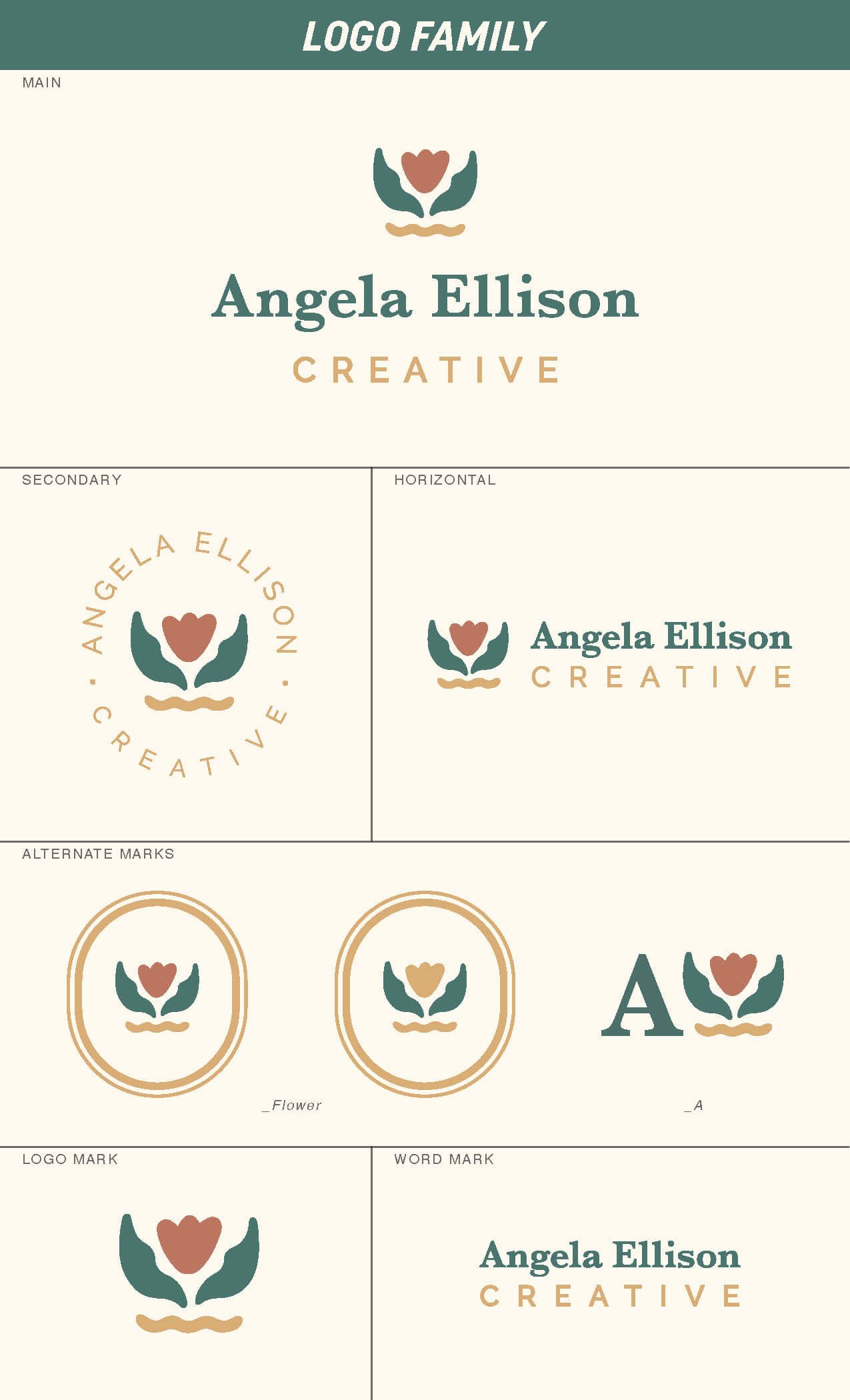
Also known as a logo suite, a logo family is a collection of logo variations that help you keep your visual brand consistent throughout a wide array of applications. Variations often include a primary logo, secondary logo, wordmark, logo mark, one-color, and black and white. Every brand is different, so your logo family should display your brand’s unique personality in order to be cohesive and memorable.
Let’s break things down into an analogy using the photos above to give you a better understanding of what a logo family is and what it can do for your brand. If you have a design background or have a well established business, you might already be familiar with the benefits of creating a logo family, feel free to skip ahead.
In the first photo featured above, there's a single pink rose in a vase. It’s pretty and might catch your attention as you pass by. You may think “how lovely!” Someone took the time to cut a single flower and bring it inside to brighten up or bring a pop of color to a space. Similarly a logo can bring life to your brand and remind people who you are and what you do.
The photo below, displays a larger flower bouquet layered with greenery and roses. This bunch of flowers was carefully arranged, multiple stems placed to add texture, depth, and color. A bouquet is much more likely to catch someone’s eyes than the single rose we were thinking about a moment ago. If you are walking past the bouquet, you might even breathe in a fresh, flowery scent. Someone took some extra time to cut and place the flowers to make sure it looked just right.
In the same way a carefully crafted logo family can help you make a larger impact with your target audience. Each logo serving a specific purpose.
You could even think about it like wildflowers. The first few blooms are going to be difficult to spot in a sea of green, but as the rest of the flowers reach full bloom there will be an explosion of color! Now that is hard to overlook! And that is exactly what the most impactful organizations are good at creating with their brand assets—a moment that is hard to miss or forget.
So you can see, a single logo can serve a purpose on it’s own, but supporting brand marks and a touch of
strategy has the potential to make a longer lasting impact. Thinking about your
visual identity
in this way, would you rather your brand be a single flower or an expansive field of wildflowers?

One more comparison to drive the concept home.
Think about a literal family—many have multiple members and each member of the family has their own role within it. Every family looks different from one to the next, some are big, some are small, but each are a family nonetheless.
A single logo is like one member of a family, they have limits to how much they can accomplish on their own and their network is limited by the number of people they can personally connect with.
On the other hand, a logo family is like all the members of a family. Each person has their own perspective and role within their family and each has their own network of friends and connections. Just like a family, a logo family can help you reach more people with your brand by creating more opportunities for touchpoints with potential clients or customers.
From here, let’s jump into the three benefits of creating a logo family.
Benefits of creating a logo family
01 Versatility
One of the benefits of expanding out your logo into a full logo family is versatility. By creating sub marks that support your primary logo, you can begin to use your brand in places that weren’t easy before.
When considering variations for your logos, you should think about where they are most often used. Every brand is unique and the logo family should reflect that.
Example: Your current logo looks great on your business cards, but now you want to order custom pens and there is no way to fit your logo across one side without wrapping around to the other side. How in the world can it be done… unless you have a horizontal version of your logo! Poof, another member of your logo family that might be good for you to have on hand.
02 Accessibility
If you scale up your logo, does it still look good? What about when it is scaled down? Chances are your logo doesn’t do both and that is when sub marks and logo marks can come in handy.
This point is especially important for intricate logos with lot of little details or lines of text. Simplifying your logo when used on a smaller scale helps ensure everything remains legible. When your logo is easily recognizable across a range of sizes, you build trust with clients and or customers.
Example: Right now your logo looks great on posters but the little details get lost when you scale it down for social media posts, digital ads, or that limited space on your product package. Having sub marks or logomarks to support your primary logo allows you to keep even the smallest of details “on brand.”
03 Memorability
Creating an expansive logo family increases memorability because they allow you to push your brand personality forward through your entire visual identity. Increasing the opportunities to connect with your audience across various touchpoints throughout your business improves brand recognition as a whole.
If you can use your logo in it’s simplest form and people start to make that connection back to your brand, that is a good sign!
Example: Think about Nike—when they first launched their brand to the world people did not know them for the famous Nike swoosh that people know them for today. Now they can include that logo mark on shoes, apparel, etc for an immediate connection to their brand.
Key Takeaways:
- Logo families are dependent on your main logo and existing brand identity
- Every logo family isn't going to look the same, one business is going to have different logo variations than another
- Not all brands need all types of logos
- What works for one brand might not work for yours because you use your logos differently and have a different audience
- Just as every logo should show a brand’s unique personality, your logo family should do the same
- Your logo family should support your primary logo
Were the analogies helpful? I aim to create content that helps you grow your business, let me know what else you'd like to know about branding. I encourage you to reach out if there is more you'd like to know, or share with a friend if you found this helpful.